Thursday, June 16, 2016

The Road Map of a Culture

“Language is the road map of a culture. It tells you where it's people came from and where they are going.” - Rita Mae Brown

The ability to communicate by sharing thoughts and ideas is crucial to human survival. It is also important in building speech communities of people who share similar beliefs or ways of speaking. That is why the revival of the Irish language is so meaningful. I found it fascinating that there is a special pin, such as the one Paula wore, that conveys information about whether or not the wearer can converse in Irish. Although the pin is a simple object, it has a much deeper meaning.

This simple gold circle is known as An Fáinne, which means “The Ring” or “The Circle.” There are three different types of pins that denote varying degrees of ability, in addition to a badge which shows sympathy to the language but not an ability to speak it
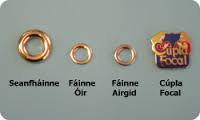
 

Today the pins are easy to obtain, but originally there was a required test to determine if a person could wear one. The idea for the pins was proposed at a meeting of the Gaelic League in February, 1916, with many of the Easter Rising rebels present. The pins were not very popular at first, because most fluent speakers did not feel the need to advertise it. However, the pins were more successful in the 1920s with nationalists who learned the language as adults, often while imprisoned for fighting with the Irish volunteer army. During the relatively peaceful years these pins faded out of use, but they became more common again in 1965.


So much culture and history is wrapped up in the words and phrases of the Irish language. Just from looking at the language it is easy to see the significance religion has had in Ireland as well as the extreme hospitality and friendliness conveyed by many of the phrases. When the Irish language became more scarce, the country lost more than mere words. Language is a powerful way to shape identity, which is why the movement to bring Irish back into use is so incredible. By requiring schoolchildren to obtain a knowledge of the language, there is a much higher chance that future generations will be fluent in Irish, thereby reclaiming some of the heritage that was lost under British rule.

The Great Irish Wolfhound

The Irish Wolfhound is one of the oldest breeds of dogs in the world; we have record of it being around in the 5th century in Ireland but it had already been an established breed at this point. This massive animal used to be much larger at the beginning of its existence but, because the larger ones were more frightening, they were most likely killed in battle. The Irish Wolfhound that we know today is much different from the ancient hound. Today they are known for their loyalty, easy-going nature, and size; while the ancient hound was known for its ruthlessness, loyalty, and ability to take down horses. The original purpose of taming the Irish Wolfhound was for its use in battle and as a guardian of homes. There is one story in which two competing kingdoms of Ireland are at war; one king is riding in the country side in his chariot pulled by two horses, a wolfhound comes bounding out of the brush and charges the chariot. She jumps onto the chariot, crushing it, tears the charioteer’s head from his body and, being unable to find the king because he runs away, kills both the horses. These dogs were not to be trifled with, they are extremely loyal to their masters and have an insane amount of power. In the Great War of 1914-1918, Great Britain used Irish Wolfhounds as ambulance dogs, messengers, and guard dogs. They were used to drag wounded men to safety and their lives were constantly risked saving hundreds of men. Great Britain used these dogs to no end and there were many heroes that will go forever unnoticed by the general population. I think that this could be used as a representation of how Britain thought of the Irish people. They accepted many Irish men into their military and used them to keep their own country in line during the Rising, almost seeming to sacrifice them to their own. 
 Ancient representation of The Great Irish Hound
 At the National Museum of Natural History in Dublin
 Modern Irish Wolfhound
Irish Wolfhound vs Great Dane

Object of offering, object of ire


The Yank's offering at Collins' grave.
A few times a year, an American woman calling herself “The Yank” visits the Glasnevin Cemetery to deliver a bright red flower, an American flag and a one-sentence note at the monument to Irish patriot Michael Collins.

Her offerings and pilgrimages to Collins’ grave are noteworthy but not extraordinary because the Irish are constantly refreshing the plot in which Collins is buried with potted plants and bouquets. Nearly 100 years after Collins was assassinated, he still commands loyalty and admiration.

A few sections of the cemetery away sits the grave of Eamon de Valera, Collins’ contemporary who became a longtime leader of Ireland.

De Valera’s grave, in contrast, was sparse. No flowers. No flags. Just gravel and a modest stone cross that was meant, initially, for his child before it became his grave marker too.

Some of us wondered why it was so understated for someone who spent 10 years as Taoiseach (or prime minister) and 14 years as Ireland’s third president.

My theory is that perhaps de Valera didn’t think he’d ever need a grave because he was a survivor. 

He was the only male leader of the 1916 Easter Rising to escape execution. I say male because women played a huge role in the planning and fighting, and seemed at the time to be moving rapidly toward equality. 

The Countess Markievicz was a key leader.
As we have learned, the Proclamation of the Republic is the first such document in the world to specifically reference women. It starts: "Irishmen and Irishwomen ..."  And many of the Rising’s commanders, such as labor leader James Connolly, were feminists. “Win the women to your cause and your cause is secure,” Connolly famously said.

The British refused to kill the women who participated in the six-day-long uprising. But the other 14 rebel leaders were shot. (The Brits didn’t consider the 25-year-old Collins, who was aide de camp to Joseph Mary Plunkett, enough of a threat, so they sent him to a prison camp in Wales.)

De Valera was a political survivor as well. Because he was the highest-ranking rebel still alive, he filled the power vacuum after the Rising and heading into the Irish War for Independence in 1919. The Irish guerrilla tactics proved so effective against the more powerful British, that the two sides set out to negotiate a treaty in 1921 that would effectively split Ireland creating a free country across most of the island but leaving six counties in the north under British rule (or "continued occupation" as our tour guide at Glasnevin Cemetery put it).
The treaty wasn't popular but did pass.

Here’s where de Valera showed what kind of political survivor he was. Instead negotiating a treaty that would inevitably involve concessions, de Valera sent Collins to do it.

And Collins paid the price with his life. The treaty sparked a civil war, and de Valera gave himself cover by denouncing the treaty’s terms. Collins, in August 1922, was assassinated in an ambush while leading a patrol in his home county of Cork.

De Valera would go on to play a key role in undoing much of the gender equality that many of his fellow rebel leaders sought because he allowed the church to essentially set social policy. 

The grave of the well-mourned Collins.
First it was a slow recession of rights – women, who briefly served as judges during the “shadow” government before independence, suddenly were excluded from juries and high-level government jobs, as Dr. Mary McAuliffe, University College of Dublin gender history professor, told our class. As the church and government blended, “respectability” became the standard and radical women were “demonized,” McAuliffe said.

Throughout our studies and travels, we've heard repeatedly that the Ireland of the 20th Century likely didn't resemble what the 1916 Rising leaders seemed to envision. And that brings us back to the note that “The Yank” lays at Micheal Collins’ grave. Our tour guide at Glasnevin said it contains a simple message that piques the imagination:

“Michael, who knows what might have been.”

Wednesday, June 15, 2016

Dreams Are Found Here

A poets mind is often seen as a confusing place, a misunderstood place, and I believe that is what creates some of the most beautiful work. Being in Ireland and walking where some of the greatest poets in history have walked, I've been enquiring a lot about just how exactly these amazing writers come up with the words to put on the paper.
When we think about a man like William Butler Yeats, we know a lot about his personality from family, friends, and diaries. He was a sensitive man and he felt everything very deeply. One thing he felt most deeply, besides his obsession with Maud, was nature. I got the chance to go to Howth, a small town about an hour away from Dublin. There, I found myself walking on Howth Cliffs, which was easily one of the most beautiful sights I have ever seen in my life. However, before we even got to the real hiking on the cliffs, we had to trek up a roadway with many spectacular houses, all with an amazing view of the coastline.
I spotted a house that old boy Yeats lived in from 1880-1883 called the Balscadden House, which is pictured below. The quote, which I learned today was about his forbidden love, Maud, really spoke to me at the time of the hike. It reads "I have spread my dreams under your feet. Tread softly because you tread on my dreams."
Looking at the scenery behind Yeats' old house, some of his poetry made more sense to me. His deeper meanings and love for nature really spoke to me when I got to be up close and personal with some of the sights that influenced his poetry. This 'object' doesn't help me understand the past of Ireland, but it helps me understand one of Irelands greatest poets, who was a big influence when it came to writing about the history of Ireland. It helps me understand the love for Ireland that everyone who fought in the Easter Rising felt so deeply. Seeing the absolute beauty that surrounded Howth Cliffs, I could finally recognize the drive behind the allegiance to Mother Ireland. Everyone who was a part of that revolution had dreams and they are scattered all over present day Ireland. As a foreigner in this wonderful country, I must tread lightly and do my best to see the land as they might have.

Earthenware Pot Oven: An Artifact of Hospitality

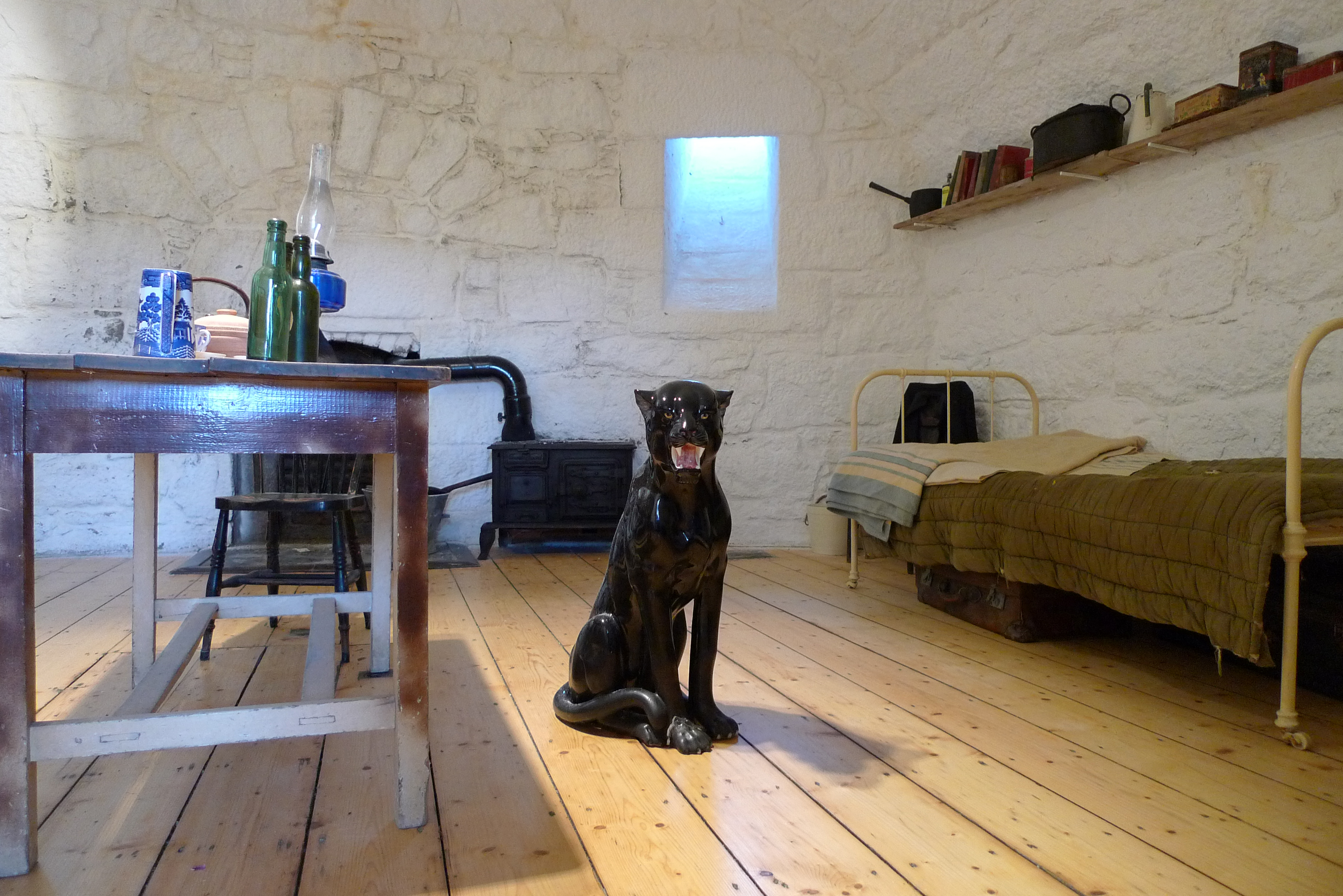
The table is laid in the James Joyce Tower.
I FIRST NOTICED THE LIDDED CLAY POT ON THE TABLE IN THE JAMES JOYCE TOWER BECAUSE I USED TO THROW POTS. At the time, I just thought it was an interesting piece of crockery, snapped my photo, and moved on. There was plenty to look at in the Joyce tower, from the black panther on the hearth, to the plank table laid for tea with traditional blue willow china, to the shelf with books and pots and bottles and jugs above the narrow bed, and the hammock slung in the corner.

The pot-oven in the Joyce Tower is about the size of a cantaloupe. It has a lid with a knob handle. It is unglazed clay, and would have been set in the embers of the fire for cooking, but I hadn't figured that out yet.
See Chapter 1 of Ulysses for a
reference to the panther.

It wasn't until a few days later, when our class read J. M. Synge's play, "Riders to the Sea," that I realized I was looking at a pot-oven: a crock for cooking Irish Soda Bread. Synge sets the scene in his play with ordinary kitchen objects: "Cathleen, a girl of about twenty, finishes kneading cake, and puts it down in the pot-oven by the fire." The pot-oven, and the soda bread baking inside it, are important links to hospitality, an idea that figures prominently in Irish literature. Darina Allen, an Irish celebrity chef tells us that baking bread was, and still is, a daily custom in Ireland. She gives us her recipe, and tells us that it only takes a few minutes to mix, and 20-30 minutes to bake.

In Synge's play, bad stuff happens when you don't tend your pot-oven, and the bread inside it closely enough. In "Riders to the Sea," the women are in charge of the hearth, the pot-oven, and the baking. I don't remember any reference to the pot-oven in Joyce's Ulysses, but seeing it on the table there in that cozy room made me wonder whether Buck Mulligan made the bread himself when he called Kinch and Haines to breakfast.
Harley Engle
The Fall of a Giant
             If you walk into the Irish Museum of Natural History, you will immediately be greeted by three complete skeletons of one of Ireland’s largest inhabitants. Megaloceros giganteus, also known as the Giant Irish Deer, last walked the earth about 10,000 years ago. It was an impressive and majestic creature. Fully grown, a male Giant Irish Deer could be 7 feet tall at its shoulders and have antlers that were 12 feet across. They were larger than the modern moose, but still maintained the elegant movements and shape of the whitetail deer we see at home. How did they get this big? The answer is actually quite simple. Even today, deer compete for mates by knocking heads and clashing their antlers together. The deer with the larger body and antlers is almost always going to come out on top. Over time, the bigger animals reproduce and create even bigger animals. Finally, we have the Giant Irish Deer that many zoologists know and love.
 M. giganteus would have been beautiful creatures that dominated their environment. Not many predators would be able to easily attack something of that size. So how did the Giant Irish Deer go extinct? There are many differing theories, but the most probable is that they became so large, and their antlers were so cumbersome, that they simply could not exist. The deer could not take in enough nutrients to support its heavy weight. Also, when predators did attack, the Giant Irish Deer was not fast enough to escape. The males could not run through the forest because their antler-span did not allow them to move between the narrow openings in the trees. There was no where they could hide, and so they were eliminated from the world.

             When given the task to relate this magnificent quadruped to Irish history, the connections were simple. Think of Megoloceros giganteus as the British Empire. Growing and growing without thinking of the consequences. It simply was not sustainable. Their huge size became their weakness, and their forces were spread too thin. This is like how the nutrients taken in by the deer could not be given to all parts of it, and so the whole creature struggled. The Irish rebels took advantage of the British being involved in other conflicts and rose up for freedom. If the British Empire had negotiated and let Ireland rule itself, then maybe it would have survived for longer. If the Giant Irish Deer did not care so much about being the largest and having the biggest antlers, it might have survived longer too. The Giant Irish Deer was beautiful and elegant, but it simply was not practical. In the end, evolution betrayed it. The biggest creatures and empires are not always sustainable.

Some images to show their incredible size and beautiful shape.


Also, the Giant Irish Deer was in the last Hobbit movie. Many people probably watched the movie not knowing that the animal actually existed at one point.

Tuesday, June 14, 2016

Grace Gifford Plunkett: A Definitely Not Unsung Hero


Like many women in history, Grace Gifford Plunkett is most well known for who she married. But this time is definitely unique: the most famous part of her story is that she married Joseph Plunkett, one of the signatories of the Proclamation and leaders of the Easter Rising, just a few hours before he was executed. This series of events has a sort of undeniable natural fascination around it, it seems some part of human nature enjoys tragic love stories, and has been immortalized through the song "Grace", a famous Irish ballad loved by many.


But we'll get to that in time. Grace was born in 1888 in Dublin, where she lived a fairly normal life. At 16 she attended art school and flourished, later able to go study in London because of her talents. 
Grace with William Orphen, her teacher
After her studies, she returned to Ireland to try and make a living as a newspaper cartoonist. She was never able to earn very much money, but Grace was already becoming politically active. Many of her cartoons were published in Irish nationalist newspapers, including The Irish Review, which, though she didn't meet him at the time, was edited by the man she would marry.

The two connected through a mutual friend, at the opening ceremony of a new bilingual (Irish/English) school on 1913. They must have known each other in passing before though, because Joseph's close friend Thomas MacDonagh, another main leader of the Rising, was married to Grace's sister. 
In 1915 Joseph proposed, and she accepted. But because Grace was raised Protestant and Joseph was Catholic, she had to convert in order to marry him. This was fine with her, but she had to take time to study Catholicism before she could officially join the church. She was accepted in April of 1916 - the wedding date was Easter Sunday. 
After their surrender, most of the leaders of the Rising were sentenced to execution by firing squad. Thomas MacDonagh was killed on May 3rd, Joseph was scheduled for the next day. Through impressive maneuvering and convincing, Joseph managed to arrange for he and Grace to be married just before midnight. 
"I was never left alone with him, even after the marriage ceremony. I was brought in and was put in front of the altar; and he was brought down the steps; and the cuffs were taken off him; and the chaplain went on with the ceremony; then the cuffs were put on him again. I was not alone with him - not for a minute. I had no private conversation with him at all. I just came away then." -Grace Gifford Plunkett
Grace and Joseph's marriage license

Grace didn't know about the details of the Rising and wasn't involved, but after her husband's death she became even more driven and politically active, using her art and influence to promote Irish nationalism.
In 1917 she was elected to be on a committee in Sinn Féin, the Irish Nationalist party. After the treaty debates she was firmly on the Anti-Treaty side of the Civil War, and at one point was arrested from February - May in 1923, imprisoned in the same jail as her husband and the other Rising leaders. Her imprisonment couldn't stop her from making art; Grace drew in the walls of her cells with crayons, most notably creating a drawing of Madonna and Child that has been recreated in the Kilmainham Jail today.
After her release Grace struggled financially and then became stable after the new government gave her a pension in 1932. Joseph had left everything to her, but legally the will was questionable because of the circumstances of it's creation while he was imprisoned. She had to take her in-laws to court to receive anything that Joseph had wanted her to have. Grace kept creating art, never remarried, and died alone in her apartment in 1955.
As a final note, I want to say that despite most historical sources referring to her as "Grace Gifford" I feel that this is incorrect. After her marriage Grace signed every piece of art as correspondence as "Grace Plunkett", and to not even include the name of her husband is invalidating to the way she felt about their marriage, as short as it might have been.